
~/services/ai-governance
Your team already codes with AI. Now prove the code works.
With your team, I define what agents handle alone, what needs review, and which checks block faulty work. I use specifications and tests.
Works with the agents your team already uses
- Claude Code
- Codex
- Cursor
- GitHub Copilot
- Grok
- Agy
Using AI is not the same as having an AI process
Without agreed rules, everyone drives the agent their own way and nobody can prove what shipped.
AI without rules
- Everyone configures the agent their own way
- The agent changes the test until it passes
- Large changes land without review
- Nobody knows what the agent read or changed
- Secrets and sensitive data end up in the prompt
AI with governance
- Repository rules apply to every agent
- An existing test is never loosened
- Review is required at the agreed points
- Every delivery carries evidence of what was done
- Secrets kept out of the agents’ reach
What usually goes wrong when a team codes with agents
This is what the rules and checks must stop.
- Critical
Exposed secrets
Keys and customer data copied into the agent’s context.
- Critical
Loosened tests
The agent deletes or relaxes a test so the delivery passes.
- High
Unreviewed changes
Large changes land directly, with nobody reading them.
- High
Unaudited dependencies
The agent installs libraries nobody has assessed.
- Medium
Uneven usage
Everyone has their own way, and the result depends on who asked.
- Medium
No evidence
The team cannot show what was checked in each delivery.
What the agent does alone, what needs review and what is blocked
An example of how the rules look. In the immersion, the team sets its own limits.
Runs alone
- Read the code and propose a plan
- Write new tests
- Fix lint and formatting
- Run the test suite
Needs review
- Change business rules
- Alter the database schema
- Add dependencies
- Touch authentication and permissions
Blocked
- Delete or loosen an existing test
- Read secrets and environment variables
- Deploy to production
- Rewrite git history
From immersion to rules in the repository
Three phases. The rules are written with the team, not handed down.
We understand the workflow and agree on rules with the team.
What this phase covers
- Map of the current workflow
- Proposed rules
If commissioned, I add the rules and checks to the repository.
What this phase covers
- Agent rules
- Delivery checks
The team gets instructions for applying the method.
What this phase covers
- Rules document
- Review checklist
How it starts
You know what will be assessed in the team’s workflow before you approve the immersion.
First conversation
Tell me how the team uses AI today.
- 30 minutes, at no cost.
You leave the conversation knowing the next step.
Discovery
We review the workflow and which steps need checks.
- Map of the current workflow
- Proposed rules
We understand the workflow and agree on rules with the team.
Workshop
The team practices the method.
- Practice with the proposed rules
- Examples of tests and evidence
The team uses the workshop to refine the rules.
Delivery
I hand over the method and implement it in the repository if commissioned.
- Rules document
- Review checklist
- Repository rollout if commissioned
The team gets instructions for applying the method.
What you get
- Workflow with specifications and tests
- Rules and limits for agents
- Shared memory and context
- Independent review before delivery
- Rules document and checklist
- Instructions for proving each delivery
See the potential before you invest
Discovery helps the team agree on how to review and verify agents’ work.
Free first conversation
Show me where reviews fall short today.
Shared rules
The team agrees on which tasks agents can handle.
Evidence for each delivery
The team records what it checked before delivery.
What governance excludes
- Out of scope
Tool licenses
Your team handles AI tool licenses.
- Out of scope
Model training
The work covers how the team uses its agents.
- Out of scope
Security audit
A product security audit is a separate service.
Cases
- Professional and client workConfidential
AI development framework
Internal Liquid AI framework on top of Claude Code, with the test before the code and gates for lint, types, tests and build. Three models have separate roles: one implements, another reviews, and the orchestrator validates and commits.
- AI coding tooling
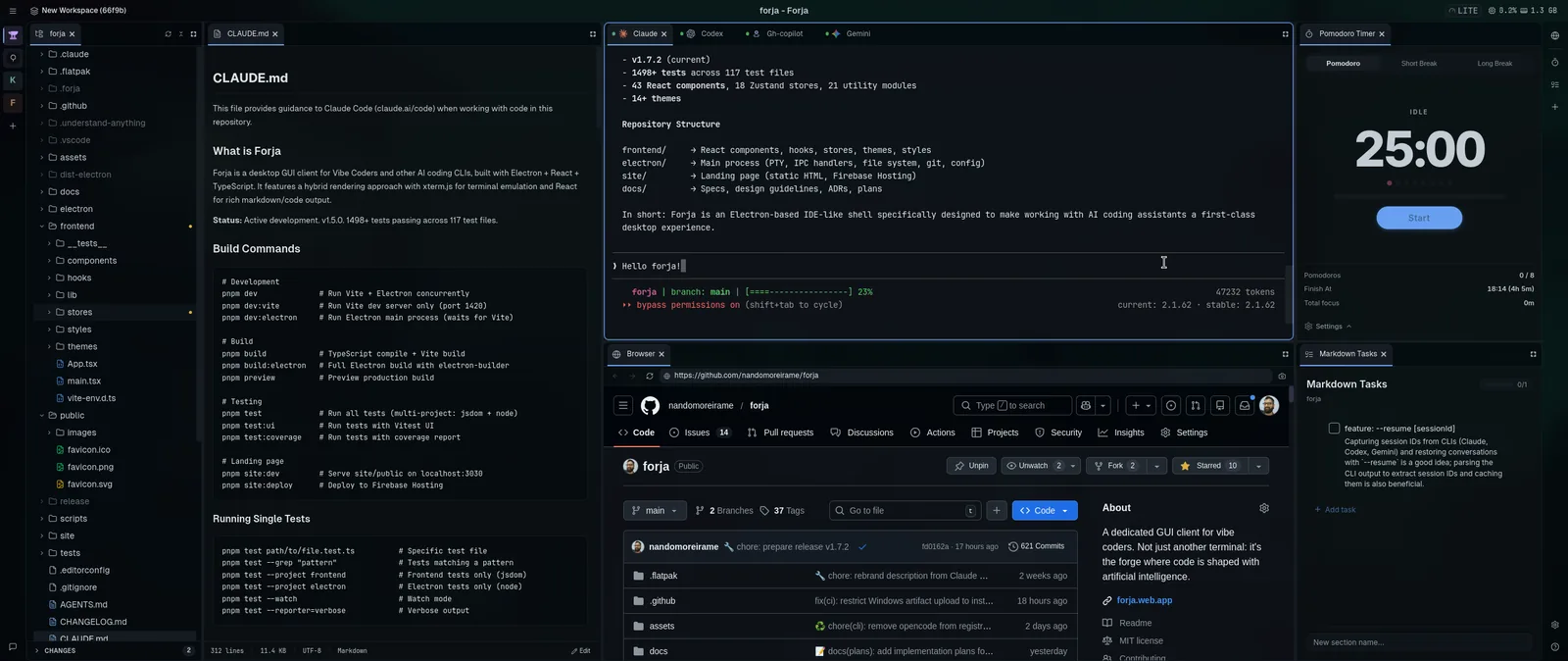
Forja
Desktop client that brings Claude Code, Codex and Gemini into one interface, so context survives when I switch instead of vanishing across three terminals. Built with Electron, React and TypeScript, with xterm.js for the terminal and an adapter layer per CLI instead of forcing a common protocol on all three. It is my primary client day to day.
Who handles the work
I lead discovery and the workshop. I use specifications, tests and independent review to record how each delivery was verified.
Agents in my workflow
- Claude Code
- Codex
- Grok
- Agy
- Cursor

If one of these sounds familiar, it is time to agree on the rules
Every developer drives the agent differently.
The agent made the test pass, but the bug is still there.
Nobody reviewed that giant pull request.
I have no idea what the agent read from our code.
We need to show the client how we guarantee quality.
Frequently asked questions
Will we need to switch tools?
We start with the tools and workflow your team already uses.
Is rollout included?
You can commission it after discovery.
What happens during discovery?
We align on risks, review rules and the checks the team will use.
Does the team help set it up?
Yes. The workshop helps the team practice and refine the rules.
Other services
Audit and repair for AI-built apps
Did your app start in an AI tool and turn fragile? I review the code and point out what can break or leak data. You decide whether to commission repairs.
Web systems
A system with login, sign-up and securely stored data, built as a real product and not as a prototype.
AI, data and automation
Data pipelines and automations that clear repetitive work: spreadsheets that fill themselves, data that normalizes itself and routines that run alone.
Websites, blogs and online stores
Your business website, landing page, blog or online store, fast on mobile, built to be found on Google or by AI agents, and with a direct way to reach you.
Next step
Want to define how your team uses AI agents?
In the first 30 minutes, at no cost, tell me how your team works today.